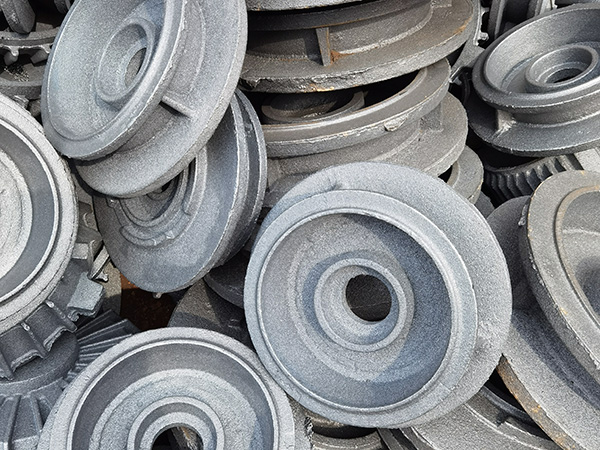
Cast Iron Parts
Cast iron parts are metal components produced by pouring molten iron-carbon alloy(typically with 2%+carbon and 1–3%silicon,plus trace manganese,phosphorus,sulfur)into precision molds,followed by cooling and solidification.Their performanc...
Cast iron parts are metal components produced by pouring molten iron-carbon alloy(typically with 2%+carbon and 1–3%silicon,plus trace manganese,phosphorus,sulfur)into precision molds,followed by cooling and solidification.Their performance is largely determined by the form of graphite in the matrix,leading to distinct material types with tailored uses for industrial,automotive,construction,and infrastructure applications.
Main Types&Key Properties
Gray Cast Iron(Gray Iron)
Graphite exists as flakes,giving excellent vibration damping,good machinability,and wear resistance,while tensile strength and ductility are lower.It is the most widely used cast iron,commonly applied to machine tool beds,engine blocks,pump housings,and pipe fittings.
Spherical graphite(achieved via magnesium-based spheroidizing treatment)delivers high tensile strength,toughness,and ductility—often comparable to cast steel.Ideal for high-stress components such as crankshafts,gears,hydraulic cylinder bodies,and heavy-duty valves.
Graphite forms as compacted clusters after annealing white iron.It offers better impact resistance and ductility than gray iron,suited for small-to-medium parts requiring bending or shock resistance,like pipe joints,hand tool components,and automotive suspension parts.
Carbon is primarily in the form of cementite(Fe₃C),making it extremely hard and wear-resistant but very brittle.Used for wear-critical surfaces such as crusher jaws,mill liners,and chilled rolls,often as a surface layer on other iron bases.
Graphite has a worm-like shape,balancing the thermal conductivity of gray iron and the strength of ductile iron.It is increasingly used in heavy-duty diesel engine cylinder heads and exhaust manifolds.
Core Advantages
Superior Castability:Low melting point and high fluidity allow complex,near-net-shape parts to be cast in one piece,reducing machining costs.
Cost-Effective:Raw materials and production processes are generally more economical than steel forgings or fabrications for large,intricate components.
Excellent Damping&Wear Resistance:Graphite structures absorb vibrations(critical for machine tools)and can hold lubricants to reduce friction.
Good Corrosion Resistance:Especially in alloyed cast irons with nickel,chromium,or molybdenum,suitable for harsh environments.
Limitations
Brittleness(except ductile/malleable grades):Poor resistance to impact and tension,not ideal for structural parts under dynamic loading without design optimization.
Poor Weldability:High carbon content easily causes cracks and white iron formation in weld zones,requiring specialized pre/post-heat treatments.
Manufacturing Process
Typical steps include:melting(cupola furnace/electric induction furnace)→alloying and spheroidizing(if ductile iron)→mold preparation(sand casting,shell casting,investment casting)→pouring&solidification→shakeout,cleaning,heat treatment(annealing,quenching)→machining,inspection(NDT,dimensional checks).
Major Applications
Automotive:Cylinder blocks,cylinder heads,brake discs,steering knuckles,gearboxes.
Machinery:Lathe beds,press frames,bearing housings,pump bodies,valve components.
Construction&Infrastructure:Manhole covers,drainage pipes,pipe fittings,water valves,bridge supports.
General Engineering:Crusher liners,grinding media,agricultural machinery parts,marine hardware.
Quality Control&Standards
Common standards include ASTM A48(gray iron),ASTM A536(ductile iron),ISO 1083,EN 1563.Quality checks involve chemical composition analysis,tensile testing,hardness measurement,ultrasonic testing,and visual inspection to ensure compliance with part requirements.