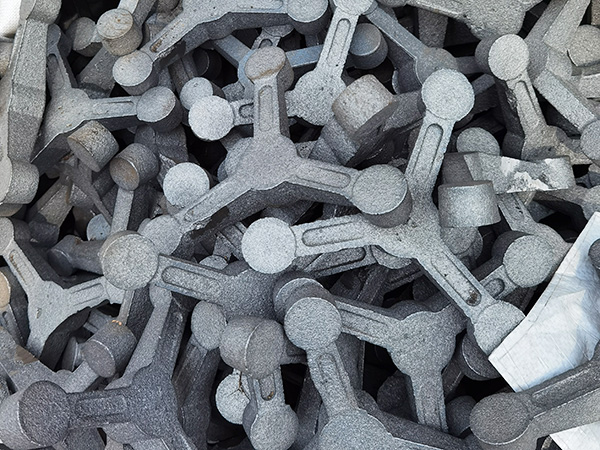
Machined Cast Iron Parts
Machined cast iron parts refer to cast iron components that undergo precision machining processes after casting,integrating the excellent castability of cast iron with the high precision and dimensional stability required for practical appl...
Machined cast iron parts refer to cast iron components that undergo precision machining processes after casting,integrating the excellent castability of cast iron with the high precision and dimensional stability required for practical applications.They are mainly processed from various cast iron materials,including gray cast iron,ductile iron and malleable cast iron,and are customized through cutting,milling,drilling,grinding and other machining operations to meet the specific size,shape and surface quality requirements of different equipment.
These parts have unique advantages:the base cast iron material provides good wear resistance,vibration damping and corrosion resistance,while precision machining ensures their dimensional accuracy(usually reaching IT7-IT9 grade)and smooth surface finish.Compared with directly cast parts,machined cast iron parts have better assembly performance,can fit closely with other components,and effectively improve the overall operation stability and service life of the equipment.They also have strong adaptability and can be processed into complex structures according to design needs.
Machined cast iron parts are widely applied in various industrial fields.In the automotive industry,they are used as engine blocks,cylinder heads and brake discs;in the machinery manufacturing industry,they serve as machine tool bases,gears and bearing seats;in the plumbing and construction industry,they are made into precision pipe fittings and valve bodies.Their cost-effectiveness and reliable performance make them indispensable core components in modern manufacturing.
With the development of precision machining technology,such as CNC machining and intelligent detection,the processing efficiency and quality of machined cast iron parts have been continuously improved,further expanding their application scope and playing a crucial role in promoting the upgrading of industrial equipment.
These parts have outstanding mechanical properties:tensile strength ranges from 350MPa to 800MPa,with good wear resistance,vibration damping and corrosion resistance.They feature excellent casting fluidity,suitable for forming complex-shaped components,and their machining performance is superior to steel,reducing production costs effectively.Advanced processes such as AI composition control and laser surface strengthening further optimize their performance and stability.
Widely used in machinery,automotive,energy and construction industries,they are core components in heavy machine tools,diesel engines,mining equipment,automotive crankshafts and municipal pipelines.For example,HT350 high-strength gray iron is widely used in precision machine tool beds,while ductile iron replaces forged steel in automotive chassis parts to reduce costs.
As a cost-effective alternative to cast steel and forged steel,high-strength cast iron parts play an irreplaceable role in promoting industrial equipment upgrading and energy conservation,with growing demand in global manufacturing.