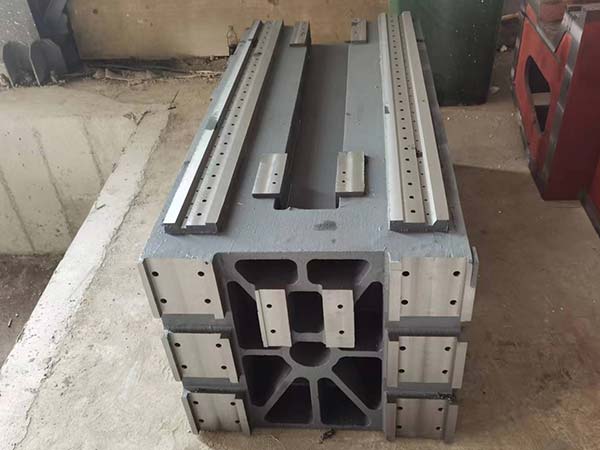
Lathe Bed Casting
Lathe Bed Casting is the core foundational component of lathes,serving as the base for installing the main spindle box,feed box,slide rest,and guideways.As thebackboneof lathe operation,it bears the total weight of the lathe,workpieces,and...
Lathe Bed Casting is the core foundational component of lathes,serving as the base for installing the main spindle box,feed box,slide rest,and guideways.As the"backbone"of lathe operation,it bears the total weight of the lathe,workpieces,and cutting forces,while absorbing cutting vibrations and ensuring the precise movement of the slide rest and tool rest,which directly determines the turning accuracy,operational stability,and service life of the lathe.
To adapt to the characteristics of lathe turning operations,lathe bed castings must have excellent comprehensive performance.They require superior vibration damping to reduce the impact of cutting vibrations on workpiece surface quality and turning precision;high rigidity and anti-deformation capacity to resist bending and torsion under long-term heavy loads and cutting forces;low thermal deformation to avoid dimensional deviations caused by temperature changes during continuous operation;and good machinability to facilitate precision processing of guideways and installation surfaces.
Grey cast iron is the preferred material for lathe bed castings,with HT250,HT300,and HT350 being the most commonly used grades.These materials have outstanding vibration damping,wear resistance,and cost-effectiveness,perfectly matching the working requirements of lathe beds.The manufacturing process adopts resin sand casting to ensure the structural integrity of the long,hollow lathe bed,with strict control over melting temperature(1490–1510°C),inoculation treatment,and sequential pouring to eliminate internal defects such as shrinkage and pores.Artificial aging treatment(550–600°C)is indispensable to reduce residual stress and ensure long-term dimensional stability.
Quality inspection strictly complies with international and national standards such as ISO 8062,ASTM A48,and GB/T 9439,including non-destructive testing(ultrasonic,magnetic particle)to detect internal flaws,and precision measurement with CMM to ensure guideway flatness and dimensional accuracy.Widely applied in ordinary lathes,CNC lathes,and heavy-duty lathes,these castings provide a solid foundation for high-precision,efficient turning processing in industrial manufacturing.