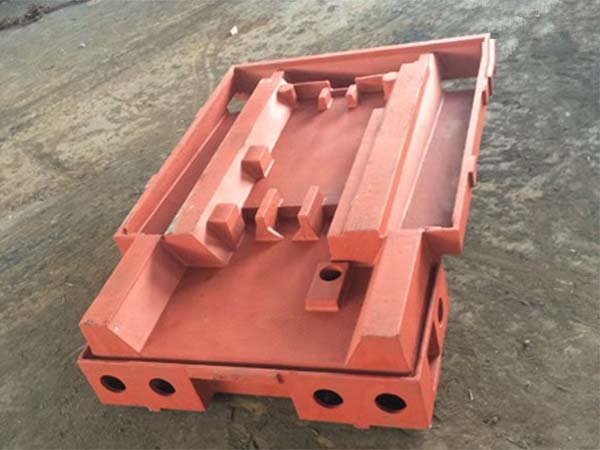
Machine Tool Castings
Machine tool castings are the fundamental load-bearing and structural components of all precision machine tools, including beds, columns, worktables, spindle boxes and slide saddles. They are the cornerstone for ensuring machining accuracy,...
Machine tool castings are the fundamental load-bearing and structural components of all precision machine tools, including beds, columns, worktables, spindle boxes and slide saddles. They are the cornerstone for ensuring machining accuracy, operational stability and long service life of equipment.
The dominant material is gray cast iron (e.g., HT250, HT300, EN-GJL-250), favored for its excellent vibration-damping performance, wear resistance, machinability and cost-effectiveness, which are critical for reducing cutting vibrations and noise. Ductile iron (QT500-7, QT600-3) is adopted for heavy-duty or high-dynamic-load machine parts to enhance strength and impact resistance.
The core manufacturing process is sand casting, supplemented by lost foam casting for complex structures and precision requirements. Strict thermal treatment (stress-relief annealing at 550–600°C) eliminates internal stress caused by uneven wall thickness, preventing post-machining deformation. Comprehensive quality control, including non-destructive testing (ultrasonic, magnetic particle), chemical composition analysis and dimensional inspection, ensures zero-defect delivery.
These castings are widely applied in CNC machining centers, lathes, milling machines, grinding machines and heavy industrial machine tools. With the advancement of intelligent manufacturing, machine tool castings are continuously optimized in material formulas, process parameters and digital detection, supporting the upgrading of the global precision manufacturing industry.