Introduction
A lathe bed casting is the structural foundation on which every other part of a lathe is mounted. It carries the headstock, feed box, carriage and guideways, and it must hold them in precise relationship while the machine removes metal. A lathe bed casting is the core foundational component of lathes, serving as the base for installing the main spindle box, feed box, slide rest and guideways. As the backbone of lathe operation, it bears the total weight of the lathe, workpieces and cutting forces, while absorbing cutting vibrations and ensuring precise movement of the slide rest and tool rest. That role directly determines turning accuracy, operational stability and service life.
This guide explains what a foundry and machine builder look for in a lathe bed: the iron grade, the internal rib layout, the way residual stress is removed, and how the guideway surfaces are brought to final accuracy. Botou Mingtu Machinery Equipment Manufacturing Co.,Ltd produces lathe bed castings as part of a wider range of machine tool castings.
What the Bed Must Do
A turning operation applies a moving cutting load to a relatively slender workpiece. The bed has to stay still under that load. It requires superior vibration damping so that cutting vibration does not mark the workpiece surface; high rigidity and anti-deformation capacity to resist bending and torsion under long-term heavy loads; low thermal deformation so that continuous operation does not cause dimensional drift; and good machinability so guideways and mounting faces can be finished accurately. These four demands shape every decision that follows, from the choice of alloy to the number of ribs under the ways.
Choosing the Iron Grade
Grey cast iron is the preferred material for lathe bed castings, with HT250, HT300 and HT350 the most commonly used grades. These materials offer outstanding vibration damping, wear resistance and cost-effectiveness, matching the working requirements of lathe beds. The graphite flakes in grey iron are what absorb vibration; a higher grade gives more tensile strength and stiffness when a heavy or long bed is specified. Graders should be selected against the machine duty rather than copied from another design: a light bench lathe and a heavy-duty CNC lathe place very different demands on the same-looking casting.
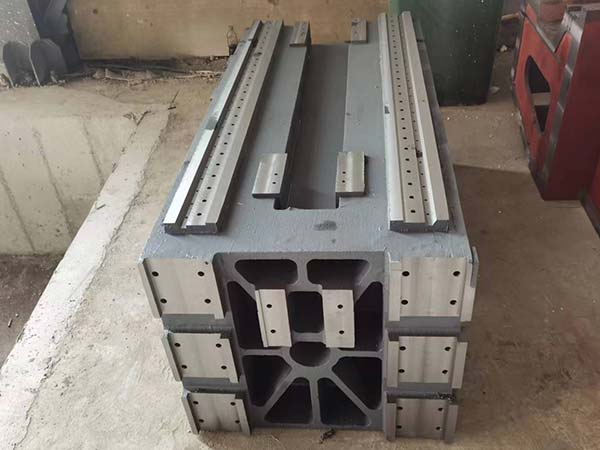
Rib Layout and Structure
The bed is rarely a solid block. Internal ribs and box sections give stiffness where it is needed while keeping weight and material cost reasonable. The layout under the guideways is the most important area, because a soft support there allows the ways to deflect exactly where accuracy matters most. Foundries use solid modelling and casting simulation to check that metal fills the mould cleanly and that thick and thin sections do not create shrinkage or pores. A well-designed rib pattern also makes the casting easier to support during machining, reducing distortion when the part is clamped.
Stress Relief Before Machining
Residual stress is created as a thick casting cools unevenly in the mould. If that stress is left in the part, it releases slowly during service and the bed loses its alignment. Artificial aging treatment at 550 to 600 degrees Celsius is indispensable to reduce residual stress and ensure long-term dimensional stability. Some producers also use natural aging for large beds, storing the casting before final machining. The sequence matters: rough machining, stress relief, then finish machining gives far more stable results than cutting the finished guideways in one pass from the as-cast state.

Guideway Machining and Inspection
Guideways are finished by precision grinding or scraping after the stress has been relieved. Their straightness, parallelism and relationship to the spindle bore decide how accurately the carriage travels. Manufacturing processes adopt resin sand moulding to control surface quality, magnetic particle inspection to detect internal flaws, and precision measurement with a coordinate measuring machine to ensure guideway flatness and dimensional accuracy. Widely applied in ordinary lathes, CNC lathes and heavy-duty lathes, these castings provide a stable foundation for the moving elements. Inspection results should be recorded so the builder can trace any later alignment issue back to the as-machined state.
Common Specification Mistakes
Buyers sometimes specify only the overall length and ignore how the bed will be supported or what load the carriage applies. It is better to share the machine layout, the maximum workpiece weight and the required accuracy class with the foundry early. Another mistake is rushing the delivery schedule so that aging is shortened; a bed that measures correctly on the day of shipment can drift once it is in service. Finally, ask how the guideways will be protected in transit, because even a small knock on a finished way can cost hours of rework.
Designing for Damping and Stiffness
Two properties dominate the performance of a lathe bed: damping and stiffness. Damping comes largely from the graphite flakes in grey iron, which convert vibration energy into heat instead of letting it ring through the structure. This is why a grey iron bed produces a better surface finish than a fabricated steel structure of similar size. Stiffness comes from the section design, particularly the depth and web thickness around the guideways. A designer must resist the temptation to remove too much material in the name of weight saving, because a lighter bed that deflects under a cutting load will never hold the accuracy the spindle is capable of. Casting simulation is used to check that the chosen walls fill cleanly and that no isolated thick region becomes a source of shrinkage.
The relationship between bed and foundation also matters. A bed bolted to an uneven floor can be pulled out of plane before it ever cuts metal, so the mounting feet must be machined coplanar and supported at defined points. Where a machine is installed on an upper floor, the dynamic behaviour of the building becomes part of the system. In such cases a heavier, better-damped bed is often the more economical choice because it isolates the cutting process from floor vibration rather than amplifying it.
Working With the Foundry
The best results come when the machine builder and the foundry discuss the part before patterns are made. Sharing the machine layout, the maximum workpiece weight and the required accuracy class lets the foundry recommend a grade, a rib layout and a realistic machining allowance. It also allows them to flag features that are difficult to cast, such as abrupt changes in section thickness or deep pockets that trap sand. A short design review at this stage is far cheaper than changing a pattern after the first articles have been poured.
Buyers should also agree how the casting will be inspected and what records will be supplied. A material certificate, a stress-relief record and a dimensional report give the machine builder a baseline for future service. When a batch of beds is involved, first-article approval locks the process before volume production begins. Botou Mingtu Machinery Equipment Manufacturing Co.,Ltd works with customers on lathe bed castings and other machine tool structures, combining casting, aging and machining under one roof so that each stage is traceable.
Frequently Asked Questions
Why is grey iron used for lathe beds? Its graphite structure damps vibration well, machines cleanly and resists wear, which suits the repeated cutting loads of turning.
Which grade should I choose, HT250, HT300 or HT350? Choose by machine duty and bed size. Heavier cuts and longer beds generally justify a higher grade for stiffness.
Why is stress relief necessary? Cooling creates internal stress. Without aging, the bed releases that stress in service and slowly loses alignment.
Are the guideways cast or machined? They are cast close to shape and then ground or scraped to final accuracy after stress relief.
Can a lathe bed be custom designed? Yes. Rib layout, mounting faces and guideway geometry can be developed around a specific machine design.
Conclusion
A lathe bed casting is not simply a large piece of iron. Its accuracy depends on the grade poured, the rib structure, the aging treatment and the care taken on the guideways. When those elements are controlled together, the bed stays stable through years of cutting and protects the investment in the rest of the machine. Botou Mingtu Machinery Equipment Manufacturing Co.,Ltd manufactures lathe bed castings alongside machine tool bases, columns and worktables, and can discuss grade, structure and machining requirements for a given lathe design.
References
[1] ISO 185:2020 — Grey cast irons, classification.
[2] ISO 8062-3:2023 — Geometrical product specifications, dimensional and geometrical tolerances for moulded parts.
[3] GB/T 9439-2010 — Grey iron castings.
[4] ASTM A48/A48M — Standard specification for gray iron castings.
[5] DIN 1691:1985 — Grey cast iron, grades and mechanical properties.
[6] ISO 1101:2017 — Geometrical product specifications (GPS), geometrical tolerancing.
[7] JJG 117-2013 — Verification regulation of surface plates.